Supercar vision model · Published 22 October 2026 · 5 min
Porsche Mission S: what is confirmed about the supercar above the 911?
Porsche has announced a permanent mid-engined platform above the 911, but Mission S is still a vision model without published power, engine, price or production timing.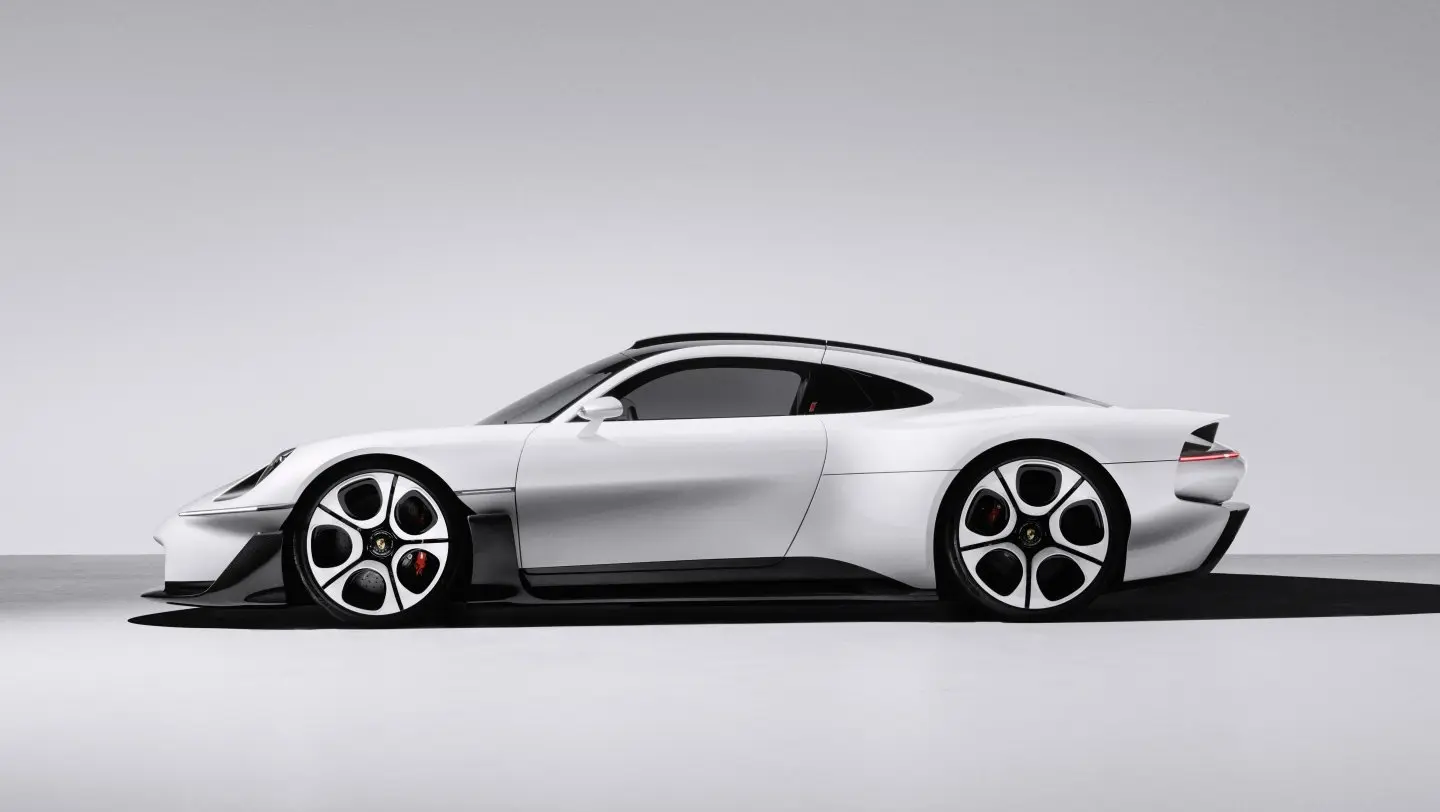
- Status
- Vision model; production platform announced
- Architecture
- Mid-engined
- Position
- Planned above the 911
- Pakistan
- No availability or price announced
A strategy signal, not a finished specification
Porsche revealed Mission S in New York on 15 October 2026. The company calls it a vision model and says it previews an evolved design identity. More importantly, Porsche says it is developing a mid-engined super-sports-car platform above the 911 as a permanent and versatile customer offer, rather than a one-off hypercar. [1]
That statement confirms product direction, not a production model’s final engineering. The release does not state an engine configuration, displacement, hybrid system, power, torque, battery, transmission, weight, acceleration, top speed, price or launch date. None should be filled from rumours or an older Porsche.
Mid-engine proportions define the show car
Porsche says the engine is positioned centrally and uses that architecture to create the Mission S profile. The body combines round headlights and pronounced fenders with references to the 911, a flat nose influenced by the GT1, and a roofline linked by the company to the 959. [1]
The engineering reason to discuss layout is mass placement and packaging, not visual nostalgia alone. A production assessment would require axle loads, centre-of-gravity data, cooling routes, luggage provision, service access and crash structure. A studio side profile cannot establish any of those outcomes.
Porsche also mentions a cooling solution reminiscent of the 917 radiator fan and a fully integrated active rear wing. The release does not publish operating modes, airflow values or downforce, so the feature cannot be ranked against another car from the image.
Analogue controls do not mean no digital system
Mission S uses five round instruments behind the steering wheel, with an analogue rev-counter needle over a display. Porsche says the instrument arrangement can move according to the drive mode. The interior combines physical switches, digital feedback and push-pull dashboard controls. [1]
There is no permanently fixed centre or passenger display. Instead, the concept includes a retractable MagSafe-compatible smartphone holder for navigation or information when wanted. This is a decision about where digital functions live—not proof that the production platform will omit a central screen.
The useful test would be whether core driving, demisting and safety functions remain clear when a phone is absent, discharged or disconnected. Ergonomics need reach, glance-time and error-rate evidence; a clean dashboard photograph alone is not validation.
The cabin borrows history without copying it
Porsche cites the 550 Spyder and 356 for the low, driver-focused interior architecture. It also retains the brand’s left-of-wheel key position and reinterprets Sport Chrono. White, grey, red and black connect the display car to Porsche motorsport colours. [1]
Historical cues are design evidence, not a mechanical family tree. Mission S should not be described as a successor to the 918 Spyder, Carrera GT or GT1 unless Porsche gives a production model that identity. Nor does a rev counter prove a particular combustion or hybrid configuration.
What to wait for before comparing it
The next meaningful evidence would be a production name, powertrain, dimensional and mass data, homologated performance, aerodynamic figures, safety specification, manufacturing plan and sale timing. A platform positioned above the 911 may support more than one derivative; the current statement does not define them.
No Pakistan launch, official importer allocation, warranty or local price has been announced. Mission S belongs in Supercars & Concepts as a documented design and product-direction story—not in Pakistan’s new-car catalogue. [1]
Primary sources
Specifications and performance figures above are manufacturer claims unless stated otherwise.
[1] Porsche Newsroom — Mission S reveal and platform announcement, 15 October 2026 ↗