Flagship sports-car engineering · Published 6 October 2026 · 7 min
Toyota GR GT: why its rear transaxle matters more than 650 PS
Toyota's developing flagship targets more than 650 PS, but its rear transaxle, all-aluminium frame and aerodynamics-first process explain how the front-engined hybrid is meant to handle.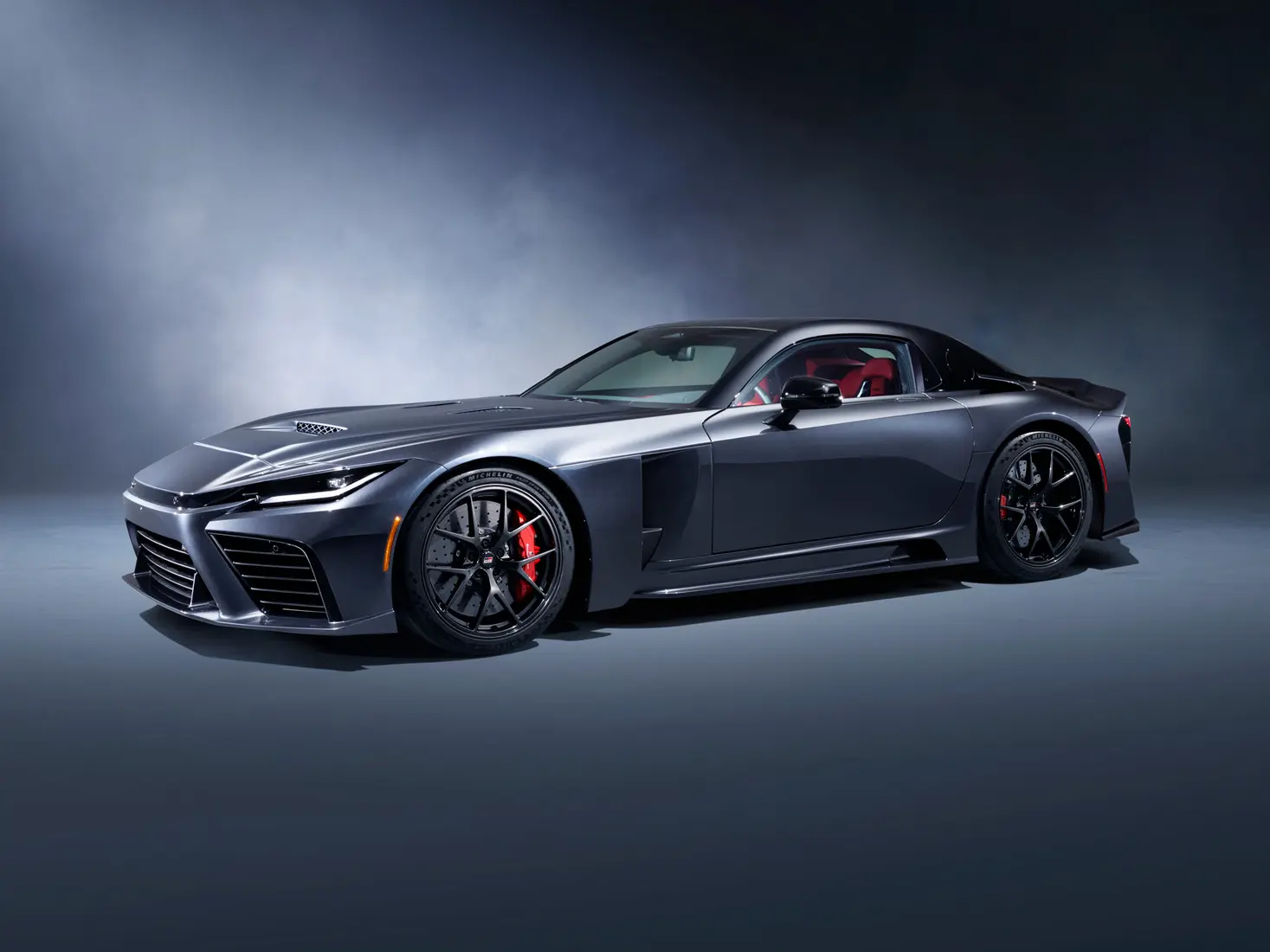
- Powertrain
- 4.0L twin-turbo V8 hybrid
- Development output
- 650 PS or greater
- Target weight
- 1,750 kg or lower
- Planned launch
- Around 2027
The gearbox location changes the car's balance
Toyota places the newly developed eight-speed automatic, single motor-generator and mechanical limited-slip differential in a transaxle at the rear. A carbon-fibre torque tube carries power from the front-mounted V8. The published development target is a 45:55 front-to-rear weight distribution. [1]
Moving the transmission rearward helps keep major masses between the axles and prevents the engine bay from carrying the complete powertrain. It does not automatically guarantee good handling: suspension geometry, damping, tyre behaviour and control calibration must still make that balance predictable at road and circuit speeds.
The hybrid system supports packaging, not electric range
The GR GT combines a newly developed 3,998 cc hot-V twin-turbo engine with one electric motor in the rear transaxle. Toyota targets at least 650 PS and 850 Nm, while using a wet-start clutch instead of a conventional torque converter. These are prototype development targets rather than final homologated figures. [1]
Toyota has not published battery capacity or electric-only range. The responsible reading is that the motor supports response, energy management and driveline integration—not that the GR GT is being presented as a plug-in commuter. Any claim about charging or zero-emission range would be speculation.
An aluminium frame is doing difficult weight work
Toyota calls this its first all-aluminium body frame and supplements it with aluminium and carbon-fibre-reinforced-plastic panels. The target vehicle weight is 1,750 kg or less, with double-wishbone suspension and carbon-ceramic brakes. [1]
A target is not a measured production kerb weight, and the definition of vehicle weight needs to remain consistent when rivals are compared. The meaningful engineering question is whether the frame can deliver crash performance, stiffness, repairability and durability while containing the mass of the hybrid system.
The shape began with airflow and cooling
Toyota says aerodynamic and cooling targets were established before the exterior was finalised—the reverse of a styling-first process. The prototype is only 1,195 mm high and targets more than 320 km/h, so airflow must provide stability while feeding the V8, intercooling, brakes and hybrid hardware. [1,2]
An aerodynamics-first process is a sound method, not proof of a drag coefficient or downforce figure. Toyota has not published either. Independent tests will need to establish high-speed balance, cooling repeatability and how the road car behaves when it is not operating on a smooth circuit.
GR GT and GR GT3 share foundations, not identical jobs
The road-legal GR GT and customer-racing GR GT3 share the 4.0-litre V8 architecture, aluminium frame concept and low-mounted double-wishbone layout. Toyota says the race car is being developed to FIA GT3 requirements and that customer support is also part of the programme. [1]
The road car still has to satisfy emissions, safety, noise, comfort and serviceability requirements that do not define the competition car. Toyota is aiming to launch both around 2027, but final specifications can change. The next useful evidence is homologation and production information—not another speculative output claim.
Primary sources
Specifications and performance figures above are manufacturer claims unless stated otherwise.
[1] Toyota Motor Corporation — GR GT and GR GT3 engineering release, 5 December 2025 ↗[2] Toyota Gazoo Racing — official GR GT development overview ↗