Supercar engineering · Published 20 October 2026 · 4 min
Gordon Murray T.50: what does its rear fan actually do?
The rear-mounted fan is part of an aerodynamic system, not a propeller driving the car. Here is how to read the manufacturer’s claims without confusing drag, downforce and power.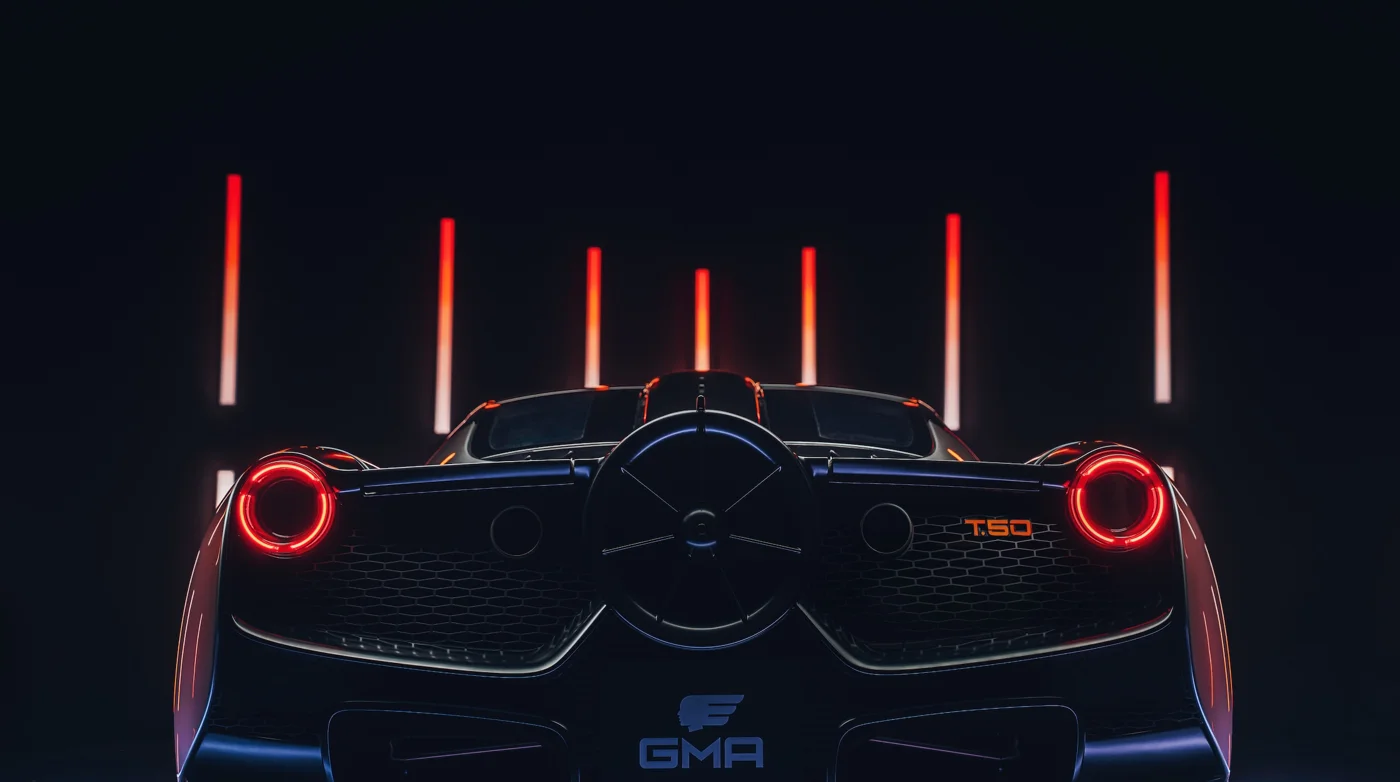
- Fan
- 400 mm, manufacturer specification
- Layout
- Central driver, two passenger seats
- Transmission
- Six-speed manual
- Context
- Global model; no Pakistan price established
A fan that manages airflow
Gordon Murray Automotive describes a 400 mm rear fan working with active rear spoilers and diffusers. The official model page says the system can alter downforce, drag and braking behaviour through different modes. Those are manufacturer descriptions of the complete aerodynamic package. [1]
The visible fan is not a substitute for the driven wheels. Its role here is to manage air around and beneath the car. Treating it as an aircraft propeller misses the purpose of the system and leads to misleading comparisons with conventional engine output.
Downforce and drag answer different questions
Downforce concerns aerodynamic load toward the road; drag concerns resistance to motion through the air. A change can favour one objective at a cost to another. A system with adjustable elements can choose different compromises, rather than delivering every advertised benefit simultaneously.
A percentage improvement is incomplete without a reference condition. Before comparing claims, ask which mode, speed, vehicle attitude and baseline were used. This article does not turn the manufacturer’s percentages into a guaranteed reduction in your stopping distance.
Nor does aerodynamic load replace tyre condition, road grip or driver judgement. A maximum claim does not mean that the same effect exists at parking speed, in every corner or in poor weather. No independent instrumented test is being presented here.
The driving position is a separate engineering choice
The official page places the driver centrally with two passenger seats to either side and describes a six-speed manual transmission. These choices concern packaging and driver interaction as well as performance. [1]
A central seat changes entry, visibility and the relationship between the driver and controls. It is not automatically the best arrangement for every journey. Practical assessment would include access, passenger needs and what the driver can see around the car, rather than only the symmetry of a photograph.
Likewise, choosing a manual describes an intended interaction. It does not establish that the car will win every acceleration test against an automatic. Different engineering priorities deserve separate evaluation.
Why we are not using a single engine-output headline
The current official model page contains inconsistent engine figures: its descriptive text and specification table disagree on output and torque. We have not resolved that discrepancy with a dated build-specific sheet, so we do not use those figures to calculate a performance ranking. [1]
This is a reminder that even a primary source needs internal consistency checks. Copying one prominent number is not verification when another section contradicts it. A buyer should obtain the final specification for the individual vehicle.
The fan and cabin photographs identify the model, but they cannot establish every mechanical specification. A global model page also does not prove Pakistan availability, local warranty support or a landed price. None of those is claimed here.
How to compare the idea fairly
For an aerodynamic comparison, use equivalent speeds and operating conditions and separate manufacturer simulation or test claims from independent measurements. For a purchase comparison, add servicing access, usable luggage space, entry and the complete transaction terms.
The T.50 is interesting because several decisions serve an intended driving experience. That is more informative than calling a fan unusual and stopping there. Ask what each component is meant to achieve, what evidence supports it and where the claim stops.
This feature is an explanation of an existing global supercar, not a new launch announcement or a first-hand drive. The linked official documentation provides the starting point for further research.
Primary sources
Specifications and performance figures above are manufacturer claims unless stated otherwise.
[1] Gordon Murray Automotive T.50 official model page, checked 20 October 2026 ↗