Supercar analysis · Published 12 September 2026 · 8 min
Lamborghini Fenomeno Roadster: what changes when the roof disappears?
The 1,080 CV V12 hybrid is familiar from the coupé. The Roadster's real engineering story is how Lamborghini rebuilt airflow, cooling and structure while retaining almost the same claimed performance envelope.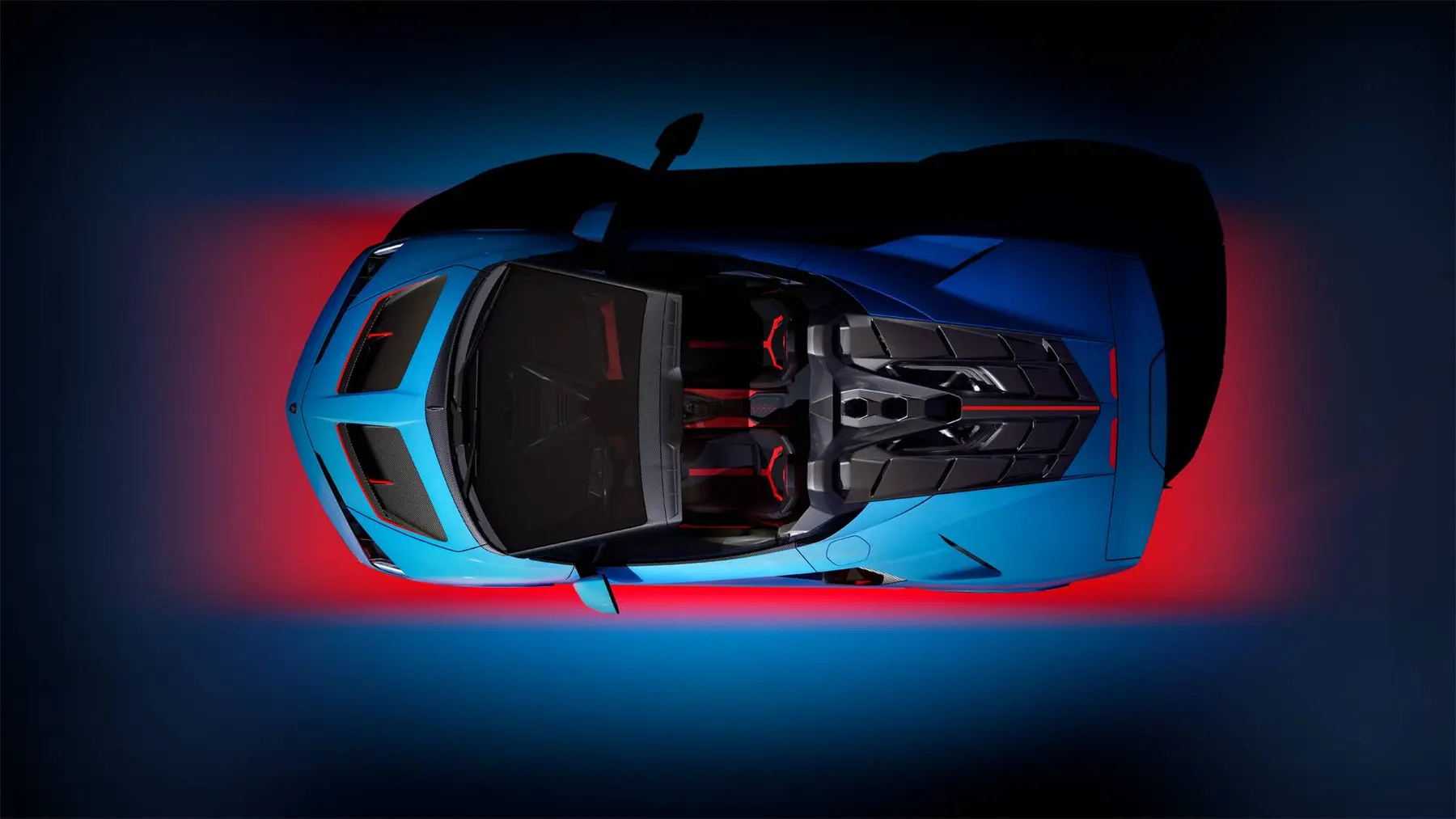
- Combined output
- 1,080 CV
- V12 output
- 835 CV
- Claimed 0–100 km/h
- 2.4 sec
- Production
- 15 cars
Removing the roof creates several problems at once
A roof contributes to structure and controls airflow before it reaches the engine bay and rear wing. Lamborghini says the Fenomeno Roadster uses redesigned upper surfaces, an additional windshield spoiler and reshaped cooling paths so that downforce, stability and balance remain close to the coupé. [1]
The windshield element guides air over the cockpit and towards the engine compartment, replacing part of the airflow function handled differently by the closed car. Carbon rollover structures must protect occupants while remaining low enough to limit turbulence. This is a system-level redesign, not simply a removable panel.
The powertrain makes the roofless car unusually demanding
The naturally aspirated 6.5-litre V12 produces 835 CV at 9,250 rpm and works with three electric motors for 1,080 CV combined. Two motors act at the front axle, while the third sits above the eight-speed dual-clutch gearbox. A 7 kWh battery also enables an electric driving mode. [1,2]
Lamborghini claims 0–100 km/h in 2.4 seconds, 0–200 km/h in 6.8 seconds and more than 340 km/h. These are manufacturer figures while type approval is still pending; they do not establish road-test repeatability, electric range or how performance changes with battery temperature and charge.
Carbon structure protects stiffness without hiding mass
The Roadster uses a multi-technology carbon monocoque and a Forged Composite front structure derived from the Revuelto's monofuselage. Lamborghini says the open car retains similar stiffness to the coupé with only a few kilograms of additional weight. [1]
That claim matters because extra reinforcement can weaken ride, braking and agility if it adds mass in the wrong places. Until independently measured figures are available, the precise weight and torsional comparison should be treated as an engineering claim rather than a proven advantage.
Track hardware still needs a road context
The Fenomeno Roadster combines manually adjustable racing dampers with CCM-R Plus carbon-ceramic brakes and bespoke 21-inch front and 22-inch rear Bridgestone tyres. A six-axis sensor estimates motion and available grip for the integrated vehicle-control system. [1]
Manual damper adjustment can be valuable for a prepared circuit but is less convenient than an adaptive road setting. Owners and testers will need to assess ride travel, steering response, brake modulation and tyre behaviour on imperfect surfaces rather than assuming racing hardware is universally superior.
Rarity is certain; dynamic equivalence is not
Only 15 examples are scheduled. That guarantees scarcity, but the relevant engineering question is whether occupants gain the sensory reward of an open V12 without losing the precision expected from the coupé. [2]
The official material establishes the architecture and targets. Independent tests must verify cockpit buffeting, heat management, body control, braking consistency and balance at different speeds. The responsible conclusion is that Lamborghini has engineered around the missing roof; it has not yet independently proved that the compromises disappear.
Primary sources
Specifications and performance figures above are manufacturer claims unless stated otherwise.
[1] Lamborghini — Fenomeno Roadster engineering and aerodynamics ↗[2] Lamborghini — official Fenomeno Roadster model specifications ↗