Supercar analysis · Published 4 September 2026 · 8 min
Aston Martin Valhalla: what three electric motors really do
Valhalla combines a flat-plane-crank V8 with three electric motors, active aerodynamics and a carbon structure. The important result is control—not just 1,079 PS.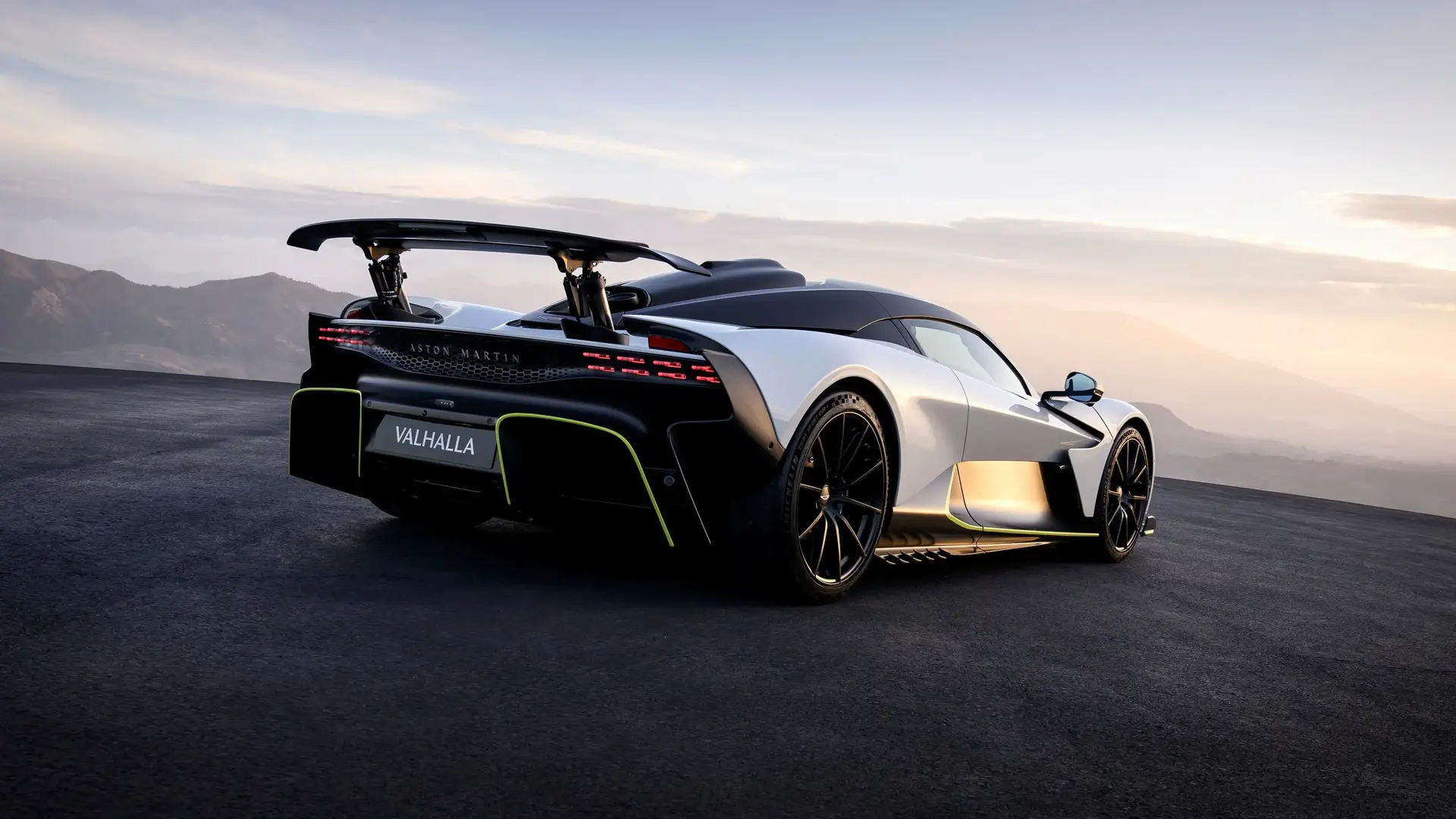
- Combined output
- 1,079 PS
- Electric motors
- Three
- Claimed 0–100 km/h
- 2.5 sec
- Production
- 999 cars
Three motors, three useful jobs
Aston Martin pairs a 4.0-litre twin-turbo flat-plane-crank V8 with three electric motors. Two sit in a front electric drive unit and can vary torque across that axle; the third is integrated into the eight-speed dual-clutch transmission at the rear. Total claimed output is 1,079 PS. [1]
The front motors provide electric drive, traction and torque vectoring. The rear motor supports starting, generation and torque fill during shifts. Electric reverse also lets the transmission omit a mechanical reverse gear. This is a packaging and control strategy, not electrification added only for a headline power figure.
A small battery can still carry a heavy workload
The high-voltage battery is rated at 6.1 kWh, 150 kW and 400 volts. That capacity is small beside a long-range electric car, but Valhalla's priority is rapid power delivery and recovery rather than long electric range. [1]
The engineering test is consistency: repeated acceleration, braking and torque-vectoring events generate heat. Independent testing must establish how performance changes as charge and temperature move away from ideal conditions.
Active aero manages balance as well as downforce
Aston Martin claims more than 600 kg of downforce at 150 mph in Race mode. A hidden active front wing works with a rear wing that rises by as much as 255 mm; the company says both can react within half a second. [1]
The system can vary aerodynamic balance, reduce drag and act as an air brake. The useful measure is not peak downforce alone, but whether front-to-rear balance remains predictable as the wings, suspension and wheel torque respond together.
The road-car compromises are deliberate
Valhalla uses a carbon-fibre monocoque, pushrod front suspension, carbon-ceramic brakes and staggered 20- and 21-inch wheels. It also carries driver-assistance systems, infotainment and road equipment that a track-only machine would avoid. Production is limited to 999 cars. [1]
That combination makes Valhalla more relevant than a lap-time special, but manufacturer specifications cannot prove steering feel, brake modulation or comfort. Its legacy will depend on whether the complex systems disappear beneath a clear driving experience.
Primary sources
Specifications and performance figures above are manufacturer claims unless stated otherwise.
[1] Aston Martin — official Valhalla specifications and engineering ↗