Electric hypercar analysis · Published 18 September 2026 · 5 min
Rimac Nevera R: why the cornering changes matter beyond 2,107 hp
Four motors make the headline possible. Tyres, torque control, brakes and aerodynamics explain how the Nevera R turns that output into useful performance—and why its test figures need dates.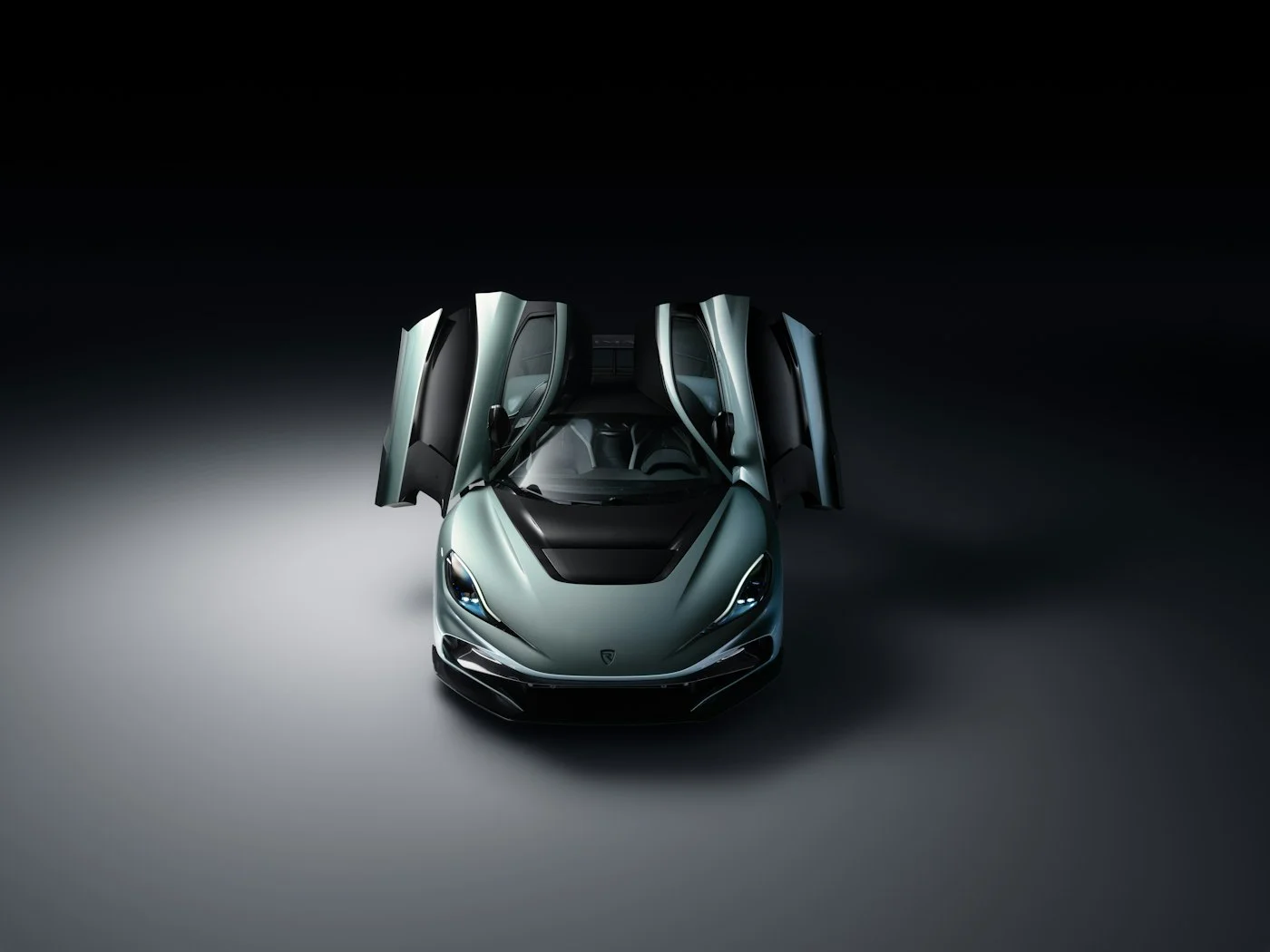
- Manufacturer output
- 2,107 hp
- Battery
- 108 kWh
- Drive
- Four electric motors
- Announced production
- 40 cars
The development brief was more than acceleration
Rimac introduced the Nevera R in August 2024 as a more cornering-focused evolution of the Nevera. Its launch material specifies a 108 kWh battery, 2,107 hp and a production limit of 40 cars, with revised torque vectoring and braking hardware. [1]
The engineering question is how those systems cooperate. A motor can ask for more force than a tyre can transmit; adding output alone does not solve that limit. The useful performance comes from managing the available grip while preserving a response the driver can understand.
Tyres and airflow change the operating envelope
The launch package combines Michelin Cup 2 tyres with a fixed rear wing and enlarged diffuser. Rimac claims 15 percent more downforce, 10 percent better aerodynamic efficiency and a 3.8-second improvement around the Nardò handling track against the standard Nevera. These are manufacturer comparisons, not CarRates measurements. [1]
Aerodynamic assistance grows with speed, whereas tyre behaviour matters from the first corner. Neither a percentage improvement nor one lap-time comparison explains all conditions. Surface temperature, tyre preparation, alignment and driver inputs can change the result. A road assessment also needs bumps, standing water and low-speed manoeuvres, where a circuit-focused setup faces different demands.
Four motors give the controller more choices
Rimac's July 2025 testing announcement describes four independently controlled motors and wheel-by-wheel power adjustments calculated 100 times per second. [2]
This architecture allows propulsion to contribute to the car's turning behaviour, as well as acceleration. But the controller still works within physical limits: it cannot create tyre grip, and it must respond coherently when the driver lifts off or brakes. The important evaluation is predictability through a whole corner, not just how quickly a control calculation repeats.
Keep launch specifications separate from later tests
The August 2024 release listed 0–300 km/h in 8.66 seconds. In July 2025, Rimac reported 7.89 seconds, a 431.45 km/h maximum and a 25.79-second 0–400–0 km/h run in high-speed mode. Rimac says Dewesoft independently verified that validation testing. These are dated test results, not a claim that every road journey can reproduce them. [1,2]
The later results should not silently replace the launch figures without explanation. Nor should a record described as world-leading in July 2025 automatically be called the current world record in September 2026. A proper comparison needs the same timing method, vehicle configuration and test conditions; a headline alone does not supply them.
Stopping and repeating the performance are separate tests
Rimac describes revised EVO2 carbon-ceramic brakes intended to improve cooling and durability under hard use. [1] A fast acceleration-and-stop result establishes one demanding capability, but it does not by itself prove repeated-lap endurance.
For sustained running, heat must leave the battery, motors, power electronics, tyres and brakes. The next useful questions concern consistency: how performance changes across consecutive laps, how braking feels as temperatures rise and how much recovery time is needed. Those questions matter more to an owner than collecting acceleration numbers under unlike conditions. The R's strongest idea is coordinated engineering; its fullest assessment still requires that wider driving context.
Primary sources
Specifications and performance figures above are manufacturer claims unless stated otherwise.
[1] Rimac — Nevera R launch engineering, 16 August 2024 ↗[2] Rimac — Nevera R validation results, 9 July 2025 ↗