Concept-car analysis · Published 14 September 2026 · 8 min
Porsche Mission X: four targets that matter more than a power figure
Porsche never gave Mission X a headline output. Instead it set targets for Nürburgring pace, power-to-weight ratio, downforce and charging—making the concept unusually useful to analyse.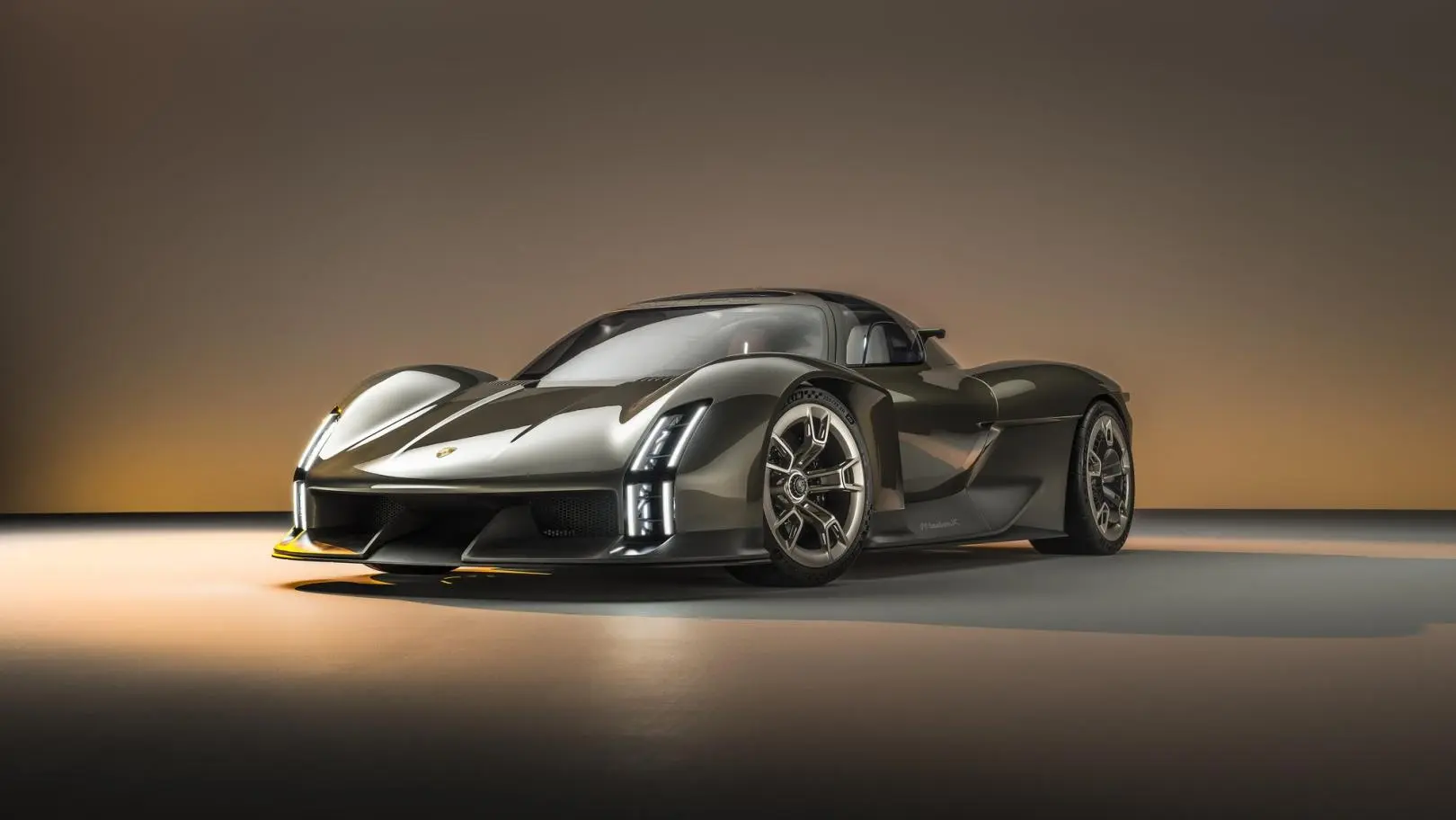
- Architecture
- 900 volt
- Power-to-weight target
- ≈1 PS/kg
- Length
- ≈4.5 m
- Status
- Concept study
Porsche published targets, not completed-car claims
Porsche describes four visions if Mission X reaches series production: fastest road-legal car around the Nürburgring Nordschleife, roughly one PS per kilogram, more downforce than the current 911 GT3 RS, and charging about twice as fast as the Taycan Turbo S using a 900-volt architecture. [1]
The conditional wording matters. Porsche did not disclose a final power figure, battery capacity, kerb weight, lap time, price or production decision. Converting these targets into settled specifications would create certainty that the manufacturer itself has not claimed.
One PS per kilogram is a mass problem first
A one-to-one power-to-weight target can be reached by adding power, removing mass or doing both. In an electric hypercar, battery energy, cooling, crash protection, motors and inverters compete directly with the low mass needed for braking and direction changes.
Porsche places the battery centrally behind the seats in what it calls an e-core layout, concentrating mass like a mid-engined car. That layout explains the concept's packaging intent, but only a final homologated weight and usable battery capacity could reveal the road-car compromise. [1,2]
Downforce and charging are part of the same performance system
Porsche wants downforce well beyond the 911 GT3 RS while using staggered 20-inch front and 21-inch rear wheels. Rear-wheel aeroblades are shaped to assist brake cooling, and the car is less than 1.2 metres high. [1]
Aerodynamic load can improve track grip but also adds drag and energy consumption. Faster charging could shorten recovery time between high-energy sessions, yet a claimed architecture voltage cannot prove a charging curve, thermal repeatability or suitable public infrastructure. Both targets must be measured over time, not at one peak point.
Compact dimensions support the agility argument
Mission X is approximately 4.5 metres long, two metres wide and uses a 2.73-metre wheelbase—dimensions Porsche compares with the Carrera GT and 918 Spyder. A CFRP exoskeleton supports a light glass dome, while Le Mans-style doors hinge at the A-pillar and roof. [1]
Compact length and a central battery can reduce polar inertia, but width, visibility, tyre behaviour and control calibration still determine whether a road car feels agile. The concept communicates proportions; it does not supply independent dynamic evidence.
What Mission X can influence even without production
Porsche calls the concept a technology beacon in the lineage of the 959, Carrera GT and 918 Spyder. Its most valuable contribution may be defining a development hierarchy: repeatable lap performance, low mass, controllable aerodynamic load and rapid energy replenishment before a record output number. [1]
A future Porsche hypercar would need to prove all four together under consistent rules. Until then, Mission X should be read as an engineering direction—not a Nürburgring record holder, a confirmed production model or a finished specification sheet.
Primary sources
Specifications and performance figures above are manufacturer claims unless stated otherwise.
[1] Porsche Newsroom — official Mission X design and technical vision ↗[2] Porsche Newsroom — Mission X official press kit ↗