Concept-car analysis · Published 29 August 2026 · 8 min
Lexus LFA Concept: why the electric successor is more than a name
The LFA name now sits on a battery-electric concept sharing an aluminium frame and development philosophy with Toyota's GR GT. The important story is what Lexus has confirmed—and what it has deliberately left open.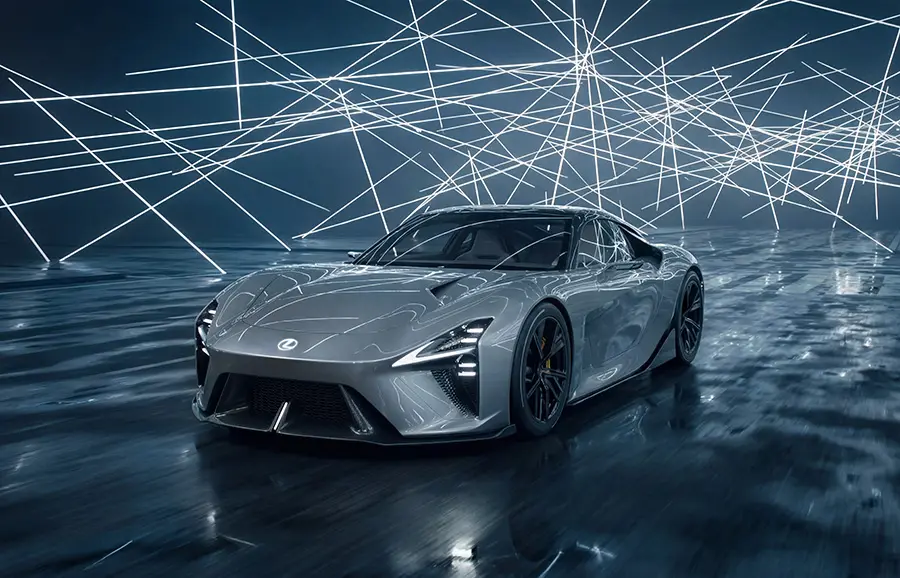
- Powertrain
- Battery electric
- Structure
- All-aluminium frame
- Length
- 4,690 mm
- Wheelbase
- 2,725 mm
First, separate the concept from the original LFA
Lexus says the LFA name is not permanently tied to one engine type. For this project it represents a car intended to preserve the most valuable engineering and craft knowledge of its era. That is a bold interpretation because the original LFA's naturally aspirated V10 was central to its identity.
The new concept is battery electric and was first shown as the Lexus Sport Concept in 2025. Its December reveal added the LFA name, an interior and partial dimensions, but Lexus still has not announced production approval or a launch date.
The shared GR GT foundation makes it technically interesting
Lexus states that the LFA Concept uses the all-aluminium body frame of Toyota Gazoo Racing's GR GT and shares its pursuit of a low centre of gravity, low weight with high rigidity and aerodynamic performance. Reusing that physical development base is more meaningful than merely borrowing styling cues.
A battery-electric sports car still faces a difficult mass problem. Aluminium can reduce structural weight, but the battery's mass, cooling demands and crash protection will decide whether a road car feels genuinely light and repeatable. Lexus has not published a battery capacity or target weight, so claims beyond that are speculation.
Packaging starts with the driver, not the screen
The official dimensions are 4,690 mm long, 2,040 mm wide and only 1,195 mm high, with a 2,725 mm wheelbase and two seats. Those proportions create a very low, wide cabin and leave a relatively long wheelbase for battery packaging.
Lexus says the cockpit is organised around an ideal driving position shared with the GR GT and GR GT3. Controls are concentrated around the driver, and the steering wheel is designed to reduce hand repositioning. This is a more useful concept claim than a giant display: control placement can survive into production even when bodywork changes.
Aerodynamics must serve both speed and range
The body combines a low nose, long flowing roof and tightly managed rear volume. Lexus describes the design as a fusion of aerodynamic performance and sculptural beauty, but it has not published drag, downforce or cooling figures.
A production EV would need to balance high-speed stability with battery and brake cooling while avoiding the drag that destroys motorway range. The GR GT relationship suggests motorsport-informed airflow work, yet the concept alone cannot prove how that compromise will perform on road or track.
The missing numbers are the ones that decide success
There is no official motor count, system output, acceleration time, usable battery capacity, charging rate, range, weight or price. Any article presenting those figures as settled is moving beyond Lexus's announcement.
Watch for a production decision, prototype testing and repeatable performance rather than a single acceleration claim. The real test will be whether Lexus can give an electric car the original LFA's clarity and sense of occasion without imitating a V10 it no longer has.
Primary sources
Specifications and performance figures above are manufacturer claims unless stated otherwise.
Lexus Global Newsroom — LFA Concept world premiere and specifications ↗Lexus Global Newsroom — original Lexus Sport Concept reveal ↗