Electric race-car engineering · Published 2 October 2026 · 6 min
Porsche 975 RSE: how 51.25 kWh can power a 45-minute race
The GEN4 Formula E car starts with roughly half the energy it needs. Up to 700 kW of regenerative braking and control software must recover the rest while balancing speed, heat and grip.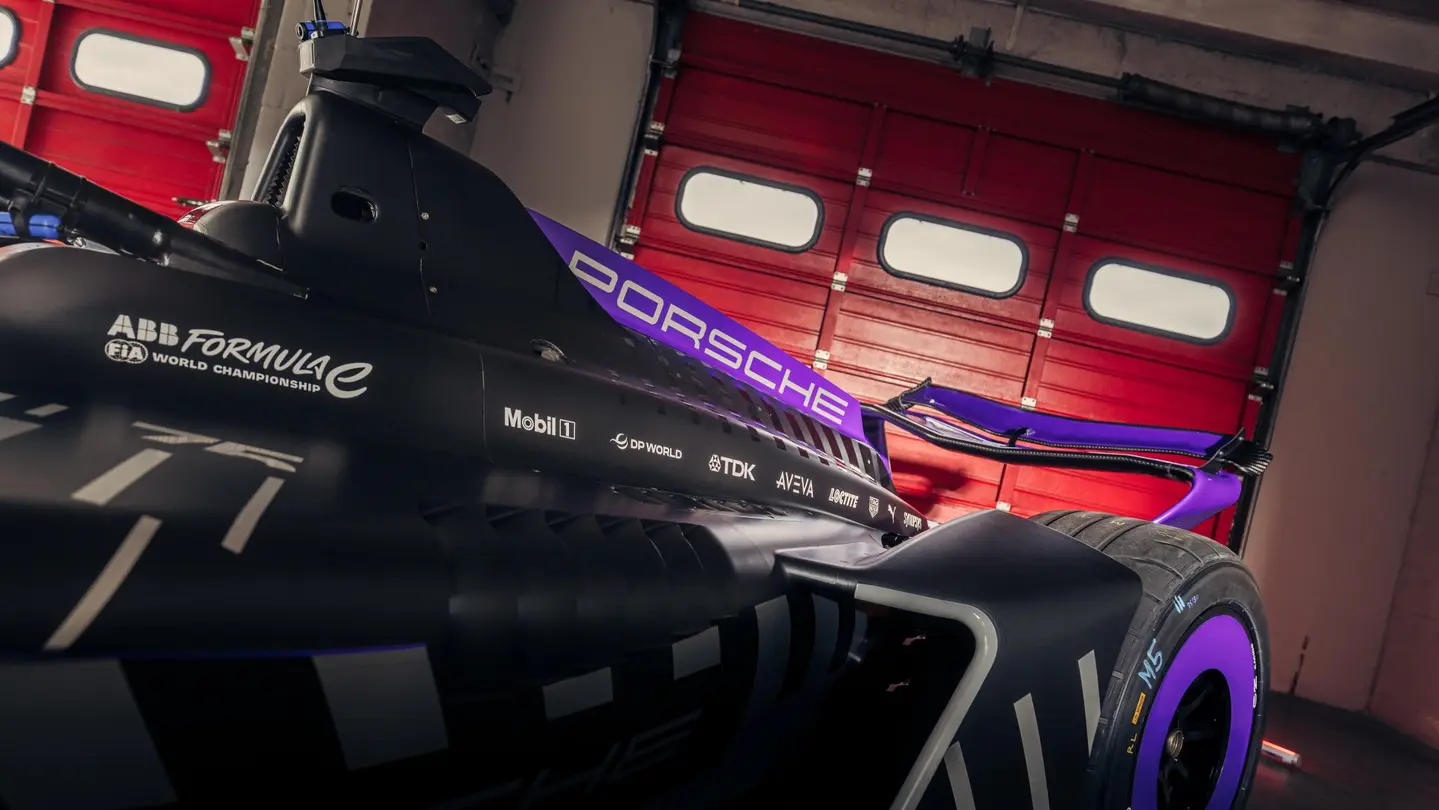
- Peak power
- 600 kW / 816 PS
- Usable battery
- 51.25 kWh
- Peak recuperation
- 700 kW
- Claimed 0–100 km/h
- 1.8 sec
The battery begins with only part of the race energy
Porsche says the 975 RSE's 51.25 kWh usable battery can support a race lasting more than 45 minutes because around half of the energy used by the car is recovered during the event. That does not mean the battery doubles its capacity; energy is repeatedly captured under deceleration and spent again on acceleration. [1]
The claim describes a race car operating under GEN4 Formula E rules, not the range or charging behaviour of a road-going EV. Track layout, race pace, tyre grip and control strategy determine how much recoverable energy is available in each braking zone.
Why 700 kW of regeneration is a control problem
Permanent all-wheel drive allows up to 700 kW of recuperation. Porsche says the oil-cooled rear motor alone can recover as much as 350 kW, while braking software coordinates the front and rear axles. [1]
Maximum recovery is not automatically best in every corner. The tyres must still provide lateral grip, the battery must accept the power and the driver must receive predictable deceleration. Software therefore has to divide braking between the motors and friction brakes while managing battery temperature and vehicle balance.
Downforce creates speed and consumes energy
GEN4 introduces separate low- and high-downforce aerodynamic packages. Porsche reports up to 150 percent more downforce than the previous generation: the lower-drag package is intended for racing, while the higher-downforce setup can be used when qualifying energy consumption matters less. [1]
That choice exposes the central Formula E compromise. Additional aerodynamic load can improve cornering speed, but drag increases the energy required on straights. A faster lap is not produced by the largest wing in isolation; it comes from choosing the best energy and tyre trade-off for the circuit.
Peak output is only available because heat is controlled
Porsche quotes 600 kW (816 PS), 335 km/h and 0–100 km/h in 1.8 seconds. These are manufacturer figures for the developing race car. The rear motor uses direct oil cooling around the stator windings, which Porsche says allows a more compact unit than comparable water-jacket cooling. [1]
The useful engineering question is repeatability. Motors, inverters and battery cells must produce and absorb large power flows throughout the race rather than for one launch. Porsche says the complete manufacturer-developed parts package gained no more than five kilograms despite the performance increase, but homologated race data will provide the fairest comparison.
What can transfer to production cars
Porsche says a nearly identical direct oil-cooling approach appears in the Cayenne Turbo Electric. The race programme also develops control units, rear-axle motor, transmission, differentials, driveshafts and operating software in-house. [1]
Road cars face different priorities—noise, comfort, durability, repair cost and charging range—but efficient heat removal and coordinated regenerative braking are directly relevant. The 975 RSE should therefore be read as a high-speed laboratory with fixed sporting rules, not as a preview of an 816 PS customer car.
Primary sources
Specifications and performance figures above are manufacturer claims unless stated otherwise.
[1] Porsche Newsroom — development of the Porsche 975 RSE, 31 August 2026 ↗