Track-only hypercar · Published 15 October 2026 · 5 min
McLaren Solus GT: why downforce matters more than its V10 headline
A single seat, a sliding canopy and a sub-tonne target make the Solus GT an unusual engineering study. Its aerodynamic load needs speed, setup and a prepared driver to become useful.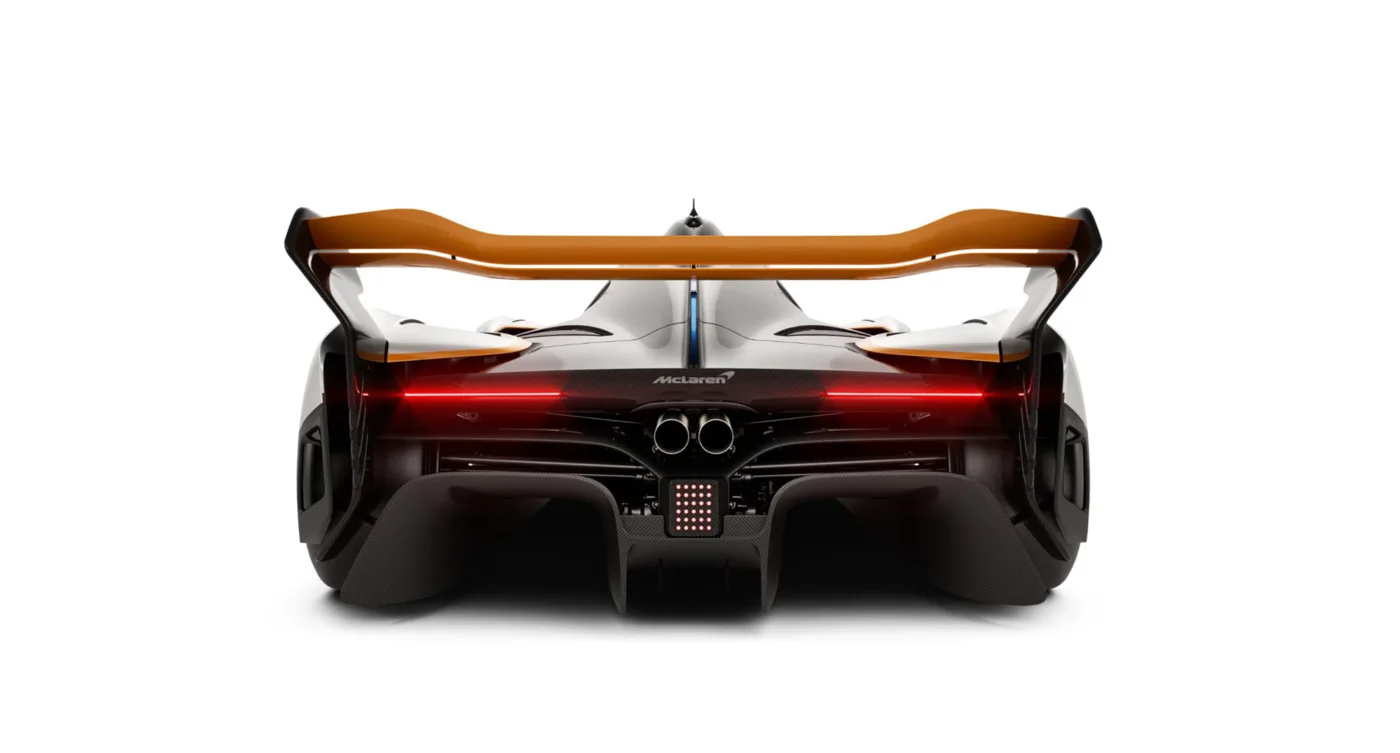
- Production commission
- 25 cars
- Engine
- 5.2-litre naturally aspirated V10
- Manufacturer power
- More than 840 PS
- Use
- Track only
A virtual idea with a very specific real-world purpose
McLaren revealed the Solus GT in August 2022 as the physical interpretation of its virtual racing concept. The manufacturer describes a 25-car commission, a central single seat, a sliding canopy and a naturally aspirated 5.2-litre V10. Its published claims include more than 840 PS and weight below 1,000 kg. [1,2]
Removing passenger accommodation and road-use requirements changes the engineering brief. Space can be allocated around airflow, cooling and the driver rather than rear seats or shopping. That freedom makes the result interesting, but it also makes direct comparisons with road-going supercars less useful. A machine designed for one task should not be judged as if it had solved every other task too.
Downforce is a load, not extra mass
McLaren’s own Trophy brochure describes 1,200 kg of downforce alongside the sub-1,000 kg vehicle-weight claim. [2] These are manufacturer figures; the downforce headline is not a constant force available at every speed.
Aerodynamic downforce pushes tyres into the surface without adding the equivalent physical mass to accelerate. In a simplified model with unchanged air density and aerodynamic behaviour, force varies with speed squared. Halving speed would therefore reduce that force to roughly one quarter. This is an explanation of the relationship, not a Solus GT wind-tunnel result.
The practical consequence is that grip can change rapidly as speed falls. A driver cannot assume the high-speed aero advantage remains during the slow part of a corner. Tyres also respond nonlinearly to load, so doubling vertical force does not simply double cornering ability. A lap-time prediction needs the complete vehicle and circuit, not a single peak number.
The wing is only the visible part of the system
The official rear image shows a substantial wing and underbody diffuser. The shape of a wing can suggest its purpose, but a photograph cannot establish the car’s aerodynamic balance or how it responds to ride-height changes.
The engineering question is how front and rear loads change together under braking, acceleration, steering and surface disturbances. A stable balance gives the driver a readable response. If one end loses support suddenly, a large peak-downforce figure may offer little reassurance. Assessing that behaviour requires instrumented testing; it cannot be inferred from dramatic bodywork alone.
A high-revving V10 changes the driving workload
McLaren states that the engine revs beyond 10,000 rpm. [1] The headline evokes sound and response, but exploiting any narrow operating window also depends on gear choice, traction and the driver’s ability to repeat inputs.
More peak power does not automatically shorten every sector. On a circuit dominated by braking and direction changes, predictable response and confidence can matter as much as straight-line acceleration. The relevant comparison would use the same tyres, circuit conditions, driver and fuel load. We have not conducted such a comparison and do not present a ranking.
The driver is part of the equipment
The central cockpit and custom-fitted seat described by McLaren place the driver at the heart of the layout. [1] Proper support helps keep the relationship between body, controls and sight lines consistent under load.
For an owner, the useful questions extend beyond whether the car physically fits. Entry and exit, restraint adjustment, visibility, heat management and clear communication with the support crew all affect the session. A tailored cockpit is valuable only when the driver can operate it comfortably and follow the required safety procedures.
What the Solus GT teaches a road-car buyer
The transferable lesson is to ask what a specification requires before it delivers its benefit. Aero needs speed and stable operating conditions; peak output needs usable traction; a specialised cockpit needs a driver who fits and understands it.
For Pakistan readers, no local official price or road-registration claim is made here. The Solus GT is a global engineering feature. Its extreme focus helps explain why a road car’s comfort, serviceability and everyday predictability are engineering achievements in their own right.
Primary sources
Specifications and performance figures above are manufacturer claims unless stated otherwise.
[1] McLaren — official Solus GT model information ↗[2] McLaren — Trophy America brochure, Solus GT manufacturer figures ↗McLaren Automotive — official reveal, 19 August 2022 ↗