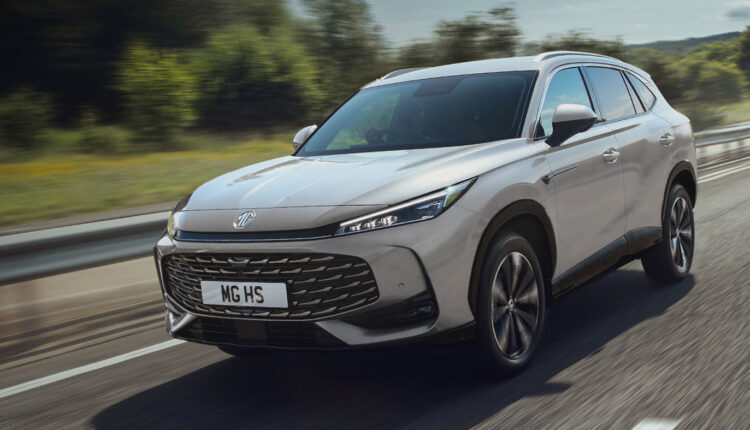
Choose the Super Hybrid around dependable charging, not the maximum range headline. MG’s charging times are estimates, and 135 km is an NEDC test-cycle claim. Obtain a current vehicle quote and a qualified installation assessment before deciding whether plug-in ownership fits your household.
What MG’s Pakistan brochure actually says
Checked on 18 October 2026, MG’s official brochure lists a 24.7 kWh nominal battery, Type 2 charging connection, estimated full-charge times of 7.5 hours with a portable charger and four hours with a 7 kW charger. These are manufacturer estimates, not our measurements. [1]
An advertised charger rating does not mean that power reaches the battery at that rate for the entire session. Charging conditions, the available supply and the vehicle’s controls affect the result. Ask the dealer to identify the supplied charger and demonstrate the connection and charging display on the actual car.
| Item | MG published figure | Buyer check |
|---|---|---|
| Battery | 24.7 kWh nominal | Do not assume nominal equals usable energy |
| Portable charging | Estimated 7.5 hours, full charge | Confirm supplied unit and approved installation |
| 7 kW charging | Estimated 4 hours, full charge | Confirm charger price and installation scope |
| Electric range | 135 km NEDC | Not a promise for your road conditions |
Check the parking place before choosing the charger
The most important question is whether the car can reliably reach a suitable charging point during the hours it is parked. In an apartment, rented home or shared driveway, obtain the relevant permission and agree who pays for the electricity before buying equipment.
Have a qualified electrician assess the supply, circuit protection, earthing, cable route and equipment requirements against the vehicle and charger instructions. This guide is not a wiring specification. Do not assume that any household socket or extension lead is suitable for sustained vehicle charging.
Ask for an itemised installation quotation: equipment, labour, any electrical upgrades and commissioning. Establish who supports the installation if charging fails. An inexpensive device is not necessarily an inexpensive complete installation.
Use measured electricity, not battery capacity alone, for the bill
For a useful ownership record, note the electricity measured at the charging point and the kilometres driven over the same period. The energy taken from the supply includes charging losses; multiplying nominal battery capacity by a tariff does not establish the cost of every charging session.
The calculation is electricity used in kWh multiplied by your applicable cost per kWh. For example, an assumed 15 kWh at an assumed PKR 60 per kWh costs PKR 900. Both numbers are illustrative inputs, not an MG consumption result or a current electricity tariff. Replace them with your measured usage and bill.
When comparing with petrol, use the same distance and record any petrol consumed as well. A plug-in hybrid can use both energy sources. Solar generation also has installation and opportunity costs, so avoid describing every solar-charged kilometre as automatically free.
Treat range as a planning question
MG’s model page explicitly identifies the 135 km figure as NEDC. It should not be compared directly with a rival’s WLTP figure as though the procedures were identical. [2]
List your normal daily journeys and the occasional longer ones. Consider air-conditioning, traffic, speed, passengers and the ability to recharge between trips. Allow a practical reserve rather than planning every day to consume the advertised maximum.
Ask for a representative demonstration, including how the car behaves when the battery is depleted. The petrol system provides another energy source; it does not remove the cost of fuel or engine servicing. We have not established a guaranteed Pakistan real-world electric range.
Price and specifications still need a written confirmation
PKR 10,199,000 was reported at the April 2026 launch. We retain it as a launch reference, not a newly verified October quotation: the checked official model page and brochure do not publish a current vehicle price. Request the complete payable amount and confirm whether a charger and installation are included. [3]
There is also an official power-label conflict. The brochure identifies 154 kW as traction-motor output and 220 kW as nominal combined output; the webpage labels 154 kW as combined power. We disclose the disagreement rather than silently treating both as equivalent. [1,2]
Before paying, obtain the current Pakistan warranty booklet, servicing requirements, charger coverage, delivery terms and cancellation conditions. Compare alternatives using the same ownership period and charging assumptions. The right plug-in is the one that fits your actual routine, not simply the one with the largest advertised electric range.
Continue your research
Verify before paying
- Get a current signed vehicle and charger quotation.
- Arrange a qualified electrical assessment.
- Use the correct range test cycle in comparisons.
- Record electricity and petrol over the same distance.
- Resolve the power-label discrepancy against the supplied specification.
Sources and corrections
The current variant and price record links to the official manufacturer or authorised distributor. CarRates writes original analysis and does not reproduce another publisher’s article.